
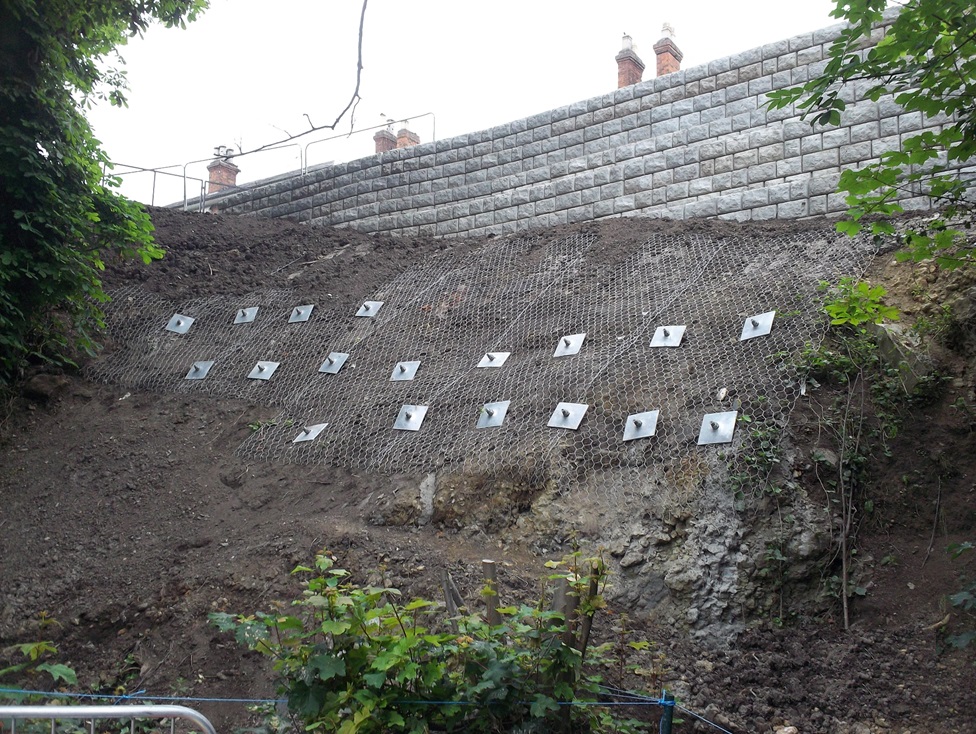
Ground slope stabilization is considered necessary if you have a slope safety factor between 1 and 1.3. For most of us, that’s not something that you can easily discern by walking out of the door and looking at the ground. In almost all cases finding the slope safety factor will require having a slope stabilization analysis performed. We highly recommend you have this done by a professional civil engineer along with a geotechnical soil test. Once you know whether the slope you’re facing be it very steep or a slow creeping, marginal slope either of which will require attention, monitoring, and most likely some form of engineering intervention, the fun begins.
There are many methods available for stopping or preventing soil erosion. Generally speaking, the soil stays put, it is gravity, rain, and wind that induce soil movement, or erosion. It is soil erosion that destabilizes slopes causing property movement, in the loss of structural supports and in extreme cases landslide. Let’s take a closer look at some of the options.
If you’re dealing with land that is in line for development or has easily disposable prior development it may be viable to flatten the slope. When you flatten a slope you reduce the weight, redistributing it more evenly. This is what makes the slope stable.
One of the most popular ways to address ground slope stabilization is through soil stabilization. The easiest way to prevent soil erosion is by planting ornamental grasses and shrubs. We suggest ornamental grasses and shrubs because they tend to leave no areas of bare exposed soil. However, any vegetation will help reduce soil erosion. Plants intercept rain and wind preventing necessary topsoil from being dislodged and moved away.
For somewhat larger areas erosion control blankets and mats are frequently used. These blankets or mats are made from biodegradable fibers and or compost. They are designed to minimize water erosion on slopes and embankments. Each mat or blanket comes rolled, you unroll the mat laying it flat on the ground. The mats then degrade very slowly allowing the natural vegetation to grow back into the area. Yet in some areas where germination, moisture and/or irrigation controls are difficult or severely stunted you want to use the compost blankets or mats. This is because a compost blanket includes organic nutrients to promote vegetation growth. Some of these products may also include seed to jump-start the growth process.
In places where the slope is very steep, you want to look into lateral supports, piles, or retaining walls. Retaining walls are very popular as they enhance the appearance and function of your landscaping. You will frequently see retaining walls around patios, parking lots, or lawn and garden spaces, though this is more likely a form of terracing. Terracing is preferred in paces with a rapid rate of erosion, and are made with wood-piles, concrete blocks, etc. It is recommended that you plant vegetation in the terraced areas to further stabilize the ground.
In some instances, you may need to create diversions to direct drainage. This is dependent on the incline of the slope. Essentially you predetermine the path excess water will follow by making open ditches and drains along the slope. With the help of a civil engineer, you can create a design that utilizes pipes and gutters, but you will want to ensure that a design of this type is installed properly otherwise it could lead to further destabilization.
For very large scale projects grouting or cement injection; or consolidation via surcharging and/or electro-osmosis will increase stability. Make sure you thoroughly look into every option before proceeding.
