
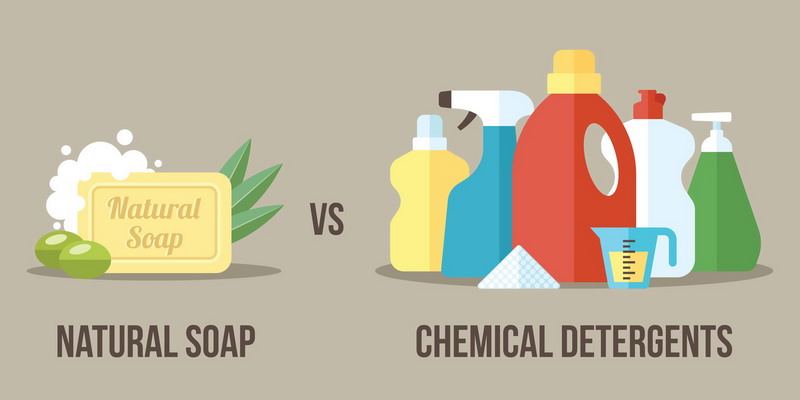
On any trip to the grocery store you can find shelves lined with a variety of detergents. There is laundry detergent, dish washing detergent, and even heavy-duty detergent to clean the grease off your hands after working on the car. A few aisles over you’ll find a complete selection of hand soaps. These are for use at the sink and in the shower.
Here is a question you have probably asked yourself at least once: is there any difference between soap and detergent? In a word, yes. There are actually a couple of differences.
How They Are Made
The first difference is how soaps and detergents are made. Soap making is the ancient art of combining plant oils and/or animal fats with a base material in order to achieve what is known as saponification. The process causes the base material to cleave to the ester bond of the oil or fat triglycerides, thus releasing fatty acid salts.
It should be noted that soap, according to the literal definition of the term, is always made with natural materials. However, modern science has strayed from that a bit. It is now possible to use synthetic ingredients to achieve saponification. The resulting synthetic soaps are not all-natural, like a beer soap, but they behave in much the same way. More on that later.
Making detergent is a bit easier in principle. You simply mix ingredients together depending on the kind of detergent you want to make. There are three broad categories of detergents: anionic, cationic, and non-ionic. Detergents in all three categories naturally heat up during the manufacturing process as a result of chemical interactions. This chemical process is not considered saponification thus detergents are not soaps.
How They Work
The second difference between soap and detergent is how they work. Both are surfactants, meaning they reduce surface tension between dirt and the surface it clings to. This allows water to wash away the dirt.
A typical soap is not as water-soluble as you might think. As it reduces surface tension, it forms little bubbles around particles of dirt. The bubbles will float to the surface of the water. This is not a problem in the shower because the constant flow of water washes away both dirt and soap.
A detergent actually grabs onto the dirt molecules and holds them tightly. The combined molecules are completely water-soluble, so they rinse away more easily. And by the way, this is why laundry detergent works better than soap for cleaning your clothes. A detergent will rinse away completely while soap will settle back into your clothing if not rinsed under running water.
Different Materials for Different Uses
At the end of the day, soaps and detergents are different materials for different purposes. A beer soap bar from the Kuhdoo Soap Company in Austin, Texas is a wonderful product for washing yourself clean in the shower after a long day of hard work. That same beer soap is not going to work in the washing machine in an attempt to get all that grease out of your work clothes.
Likewise, a dish washing detergent is an excellent choice for cleaning up the dinner dishes at the end of the evening. It’s a bit much for putting in the bathtub before a good soak. And it certainly wouldn’t be appropriate for cleaning up chemicals in an industrial setting. For that you need a much stronger detergent.
So now you know. Soap and detergent are not the same thing. The differences may be minor, but they are enough to warrant having both kinds of products.
