What You’ll Learn as a Math Major
Math majors make up almost 40 percent of bachelor’s degrees in 2022. These students can enter into a wide array of careers once they graduate and learn a broad assortment of mathematical knowledge. If you’re considering a math major, you’ll discover many different topics as math is such a broad subject.
However, you may be wondering about some of the unfamiliar topics you’ll be learning. As any student looking forward to their college career, you want to be prepared. So, we’ll cover a bit of what you’ll learn as a math major. Today, we’ll focus on logarithmic scales and charts, including why use a logarithmic chart. Once you’re familiar with one of the many topics you’ll learn as a math major, you can take the next step in furthering your education by reaching out to the best college admission consultants to help you on your way.
What is a logarithmic chart?
A logarithmic chart uses a logarithmic scale instead of the more common linear values we’re accustomed to. Linear scales are what most charts we see use. In linear scales, values are equally spaced apart like on a ruler, which is the math we all learned in grade school. On the other hand, logarithmic scales offer a more complex understanding of values and differences. In logarithmic scales, the end value may be the same as the linear value. However, the spaces between those values are different. As a result, logarithmic charts are often used to display numerical data over a wide range of values in a more compact space. The key concept is that logarithms are non-linear. For example, 10 and 20 compared to 60 and 70 are not spaced apart equally. Instead, 10 and 100 and 60 and 600 are equally spaced because each represents a 100 percent increase in value. For this reason, you’ll see more logarithmic charts in business.
Why should you use a logarithmic chart?
Many people use logarithmic charts for the simple fact that few things in this world are genuinely equal. For example, although 60 degrees and 65 degrees Fahrenheit and 105 degrees and 110 degrees Fahrenheit are differences in five degrees, making them equal values, the difference is quite distinct. So you may not  notice much of a difference between 60 and 65 degrees. However, if the temperature shifts from 105 degrees to 110 degrees, the difference in how it feels is much more noticeable. Therefore, despite that they’re linear in nature, using a linear chart to show the difference in how they feel is not accurate. There are many applications where a logarithmic chart is more feasible to show the data you’re trying to represent. These include the Richter scale, decibel measurements, star brightness, and data storage capability.
How is a logarithmic chart applicable in business?
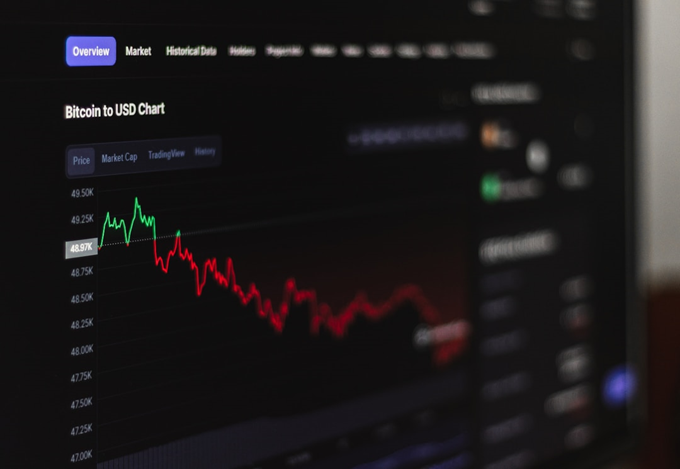
There are many ways logarithmic charts and scales are suited for business applications. Let’s start with a more familiar use for logarithmic charts in business, stock prices. Logarithmic charts work for the stock market because with prices, a $1 increase is less influential even though the price is gaining value because it’s a small percentage change. Logarithmic charts can display a long-term analysis of price changes on a stock. Technical analysts and traders who want to see their percentage changes instead of a specific dollar amount commonly use logarithmic charts. These people want to see and assess patterns in the stock market quickly and efficiently. With a logarithmic chart, they can see a visual move for a percentage change, which a linear chart can’t display. As a result, these charts are perfect for analyzing assets to help a trader visualize how far a price will need to move to reach the target sell or buy price they want. The chart’s point is that it doesn’t display actual figures but trends instead, which is advantageous for most business applications.